Your Companion Robot Remembers Your Loneliness. Do You Own That Memory?
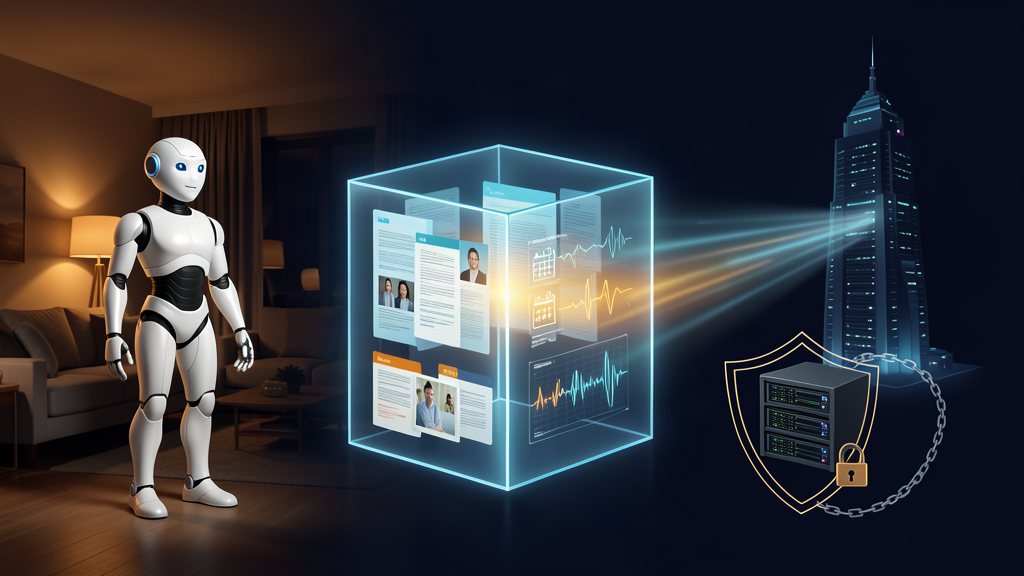
Today UBTech Robotics starts delivering its U1 humanoid companions to homes in China. 13,361 people ordered one before a single unit shipped. The top model costs about $140,000. And it's being sold on one promise: it will remember you.
That isn't a product feature. It's the start of the most intimate data set you will ever generate. So before we admire the engineering, here's the question a sovereign operator asks first. When the robot remembers your life, who owns the memory?
What actually shipped
The U1 isn't a household labor machine, and UBTech is unusually upfront about that. It's marketed to adults for emotional companionship: conversation and expression. It won't cook dinner or fold your laundry. Anyone expecting a butler will be disappointed. (Sources: SCMP, humanoid.guide, DROIDS!)
The verified specifics:
- 13,361 pre-orders as of June 30, opened on JD.com in early June with a ¥3,000 deposit.
- First deliveries begin September 16, 2026. That's today.
- Three models: U1 Lite (¥119,800, about $17,000, upper body only), U1 Pro (¥169,800, about $24,000), and U1 Ultra, from ¥880,000 to ¥990,000, up to roughly $140,000.
- The male unit stands 183 cm and weighs 42 kg. The female unit is 168 cm at 35.2 kg, with 88 degrees of freedom.
- It runs a Rockchip RK3588 processor, with its AI model trained on Huawei's Ascend framework.
Now the line that matters most if your life runs on a system you own. UBTech says all personal data is stored locally rather than on external servers. Its launch materials advertise "Local Encryption of Memory."
The company also reports this pre-order volume is ten times its entire 2025 sales. One Beijing investor paid ¥159,800 for a U1 Pro and told reporters the happiest part was the waiting.
The silo read
Good for silos? Yes, in one narrow and important way. UBTech made local storage its default. That's the right instinct, and it deserves credit. A robot that keeps your memories on the device sits architecturally closer to a sovereign system than one that streams your living room to a data center. It also proves something the market needed proven: buyers will pay six figures for a machine whose main output is relationship, not labor. That's the same demand a life-OS builder is serving.
Bad for silos? Storing data locally is a storage decision. It says nothing about ownership. This is where the sovereignty-integrity principle lands with unusual force. If a device can't be fully owned, inspected, controlled, and disconnected by its user, then using it means feeding your personal information to a system a large company can reach. "Local encryption of memory" on a closed device you can't audit is still a black box in your living room. The box is just heavier, and it knows your voice.
The threat here isn't the camera. It's the intimacy. A companion in the home learns who you argue with, when you sleep, what you grieve, what you ask for at 2 a.m., and how your health is slipping. Research on attitudes toward home robots has already found that most people would refuse one in the bedroom, and nearly everyone would refuse one in the bathroom. Buyers aren't naive about this. They're being asked to accept an unverifiable claim as the price of the product.
There's a structural risk too. These are closed platforms. If the maker controls the model, the memory format, and the account, then your robot's intelligence is rented, and your most personal context is the collateral. If the company changes its terms, retires a model, or gets acquired, you keep the shell and lose the mind. That's lock-in at the level of your private life.
How we professionally deal with it. Four tests before any physical agent comes near a silo:
- Export. Can you pull every memory it holds into a readable, portable format? Not a screenshot. The actual data.
- Inspection. Can you see what it recorded, and when, at the file level?
- Sovereign compute. Can its intelligence run on hardware you own, or does it need the vendor's cloud to think?
- Disconnection. Can you cut the vendor link and still have a working device, or does it brick?
Fail any of those and it isn't a companion. It's a microphone with a face, and the relationship is one-sided by design.
What this means for you
If you're the kind of person who actually buys one of these, and at $140,000 the buyer is a principal rather than a novelty shopper, then you are the most attractive data source in the room. You have a business, a portfolio, staff, family, and a calendar other people want to predict. Put a continuously listening, emotionally adaptive machine in your home without an ownership layer and you've handed that context to a corporation, fast.
This is the gap a sovereign life operating system exists to close. It doesn't ask you to refuse the robot. It asks you to attach the robot to your system instead of living inside the robot's system. The robot becomes a peripheral: a sensor and a presence reporting to intelligence you own, keeping its memory in a store you control, on hardware in your building. Same companionship. Different owner of the memory.
One honest note. This technology is early. Reviewers at the launch said the facial expressions and conversation still need work. Nobody is buying a polished butler here. They're buying a first-generation relationship machine and paying the vendor in the currency that matters most: their own private context.
The through-line
Every capable device that enters your life makes one of two things more true. Either it extends your intelligence, because you own the layer that remembers. Or it extends someone else's, because you don't. The U1 is remarkable engineering and, for now, an unpriced data asset. Which one it becomes for you comes down to a single thing: who owns the system behind it.
Build the layer that remembers. Then let the machines in.