AI Compute Is Moving Into Orbit. Your Data Boundary Still Matters.
AI compute in orbit sounds like a story about power and scale. For a SiLO operator, the more useful question is simpler: if intelligence can move farther from your desk, what stays under your control?
Google’s Project Suncatcher has reached an early milestone. It is not an orbital data center, and it is not a new private-AI service. Still, it offers a timely way to separate more compute from more sovereignty.
What Google has demonstrated
Google launched a prototype satellite for Project Suncatcher on October 1, 2026, to test whether its tensor processing units can operate in space. On October 30, Google reported that the satellite returned its first AI response: an onboard Gemma 4 model generated a haiku after receiving a prompt during a ground-station pass. The company says the next tests will examine thermal stress and radiation exposure. Two interconnected satellites are a planned 2027 milestone, not an operating service today.
That is a real engineering step, but a narrow one. Google describes Suncatcher as a long-term research effort exploring whether space could eventually host scalable machine-learning infrastructure. A first response from one prototype does not demonstrate a commercial orbital data center, reliable large-scale service, or a new option for private workloads.
Sources: Google’s October 30 satellite update; the October 1 launch announcement; Project Suncatcher’s research overview.
More computing capacity does not settle the ownership question
If orbital infrastructure matures, it could become another source of specialized AI capacity. That may expand what connected businesses can do. But a remote processor is still remote: the decisive questions are who can see the inputs, what the operator logs, which systems handle telemetry and backups, and what happens when the connection or provider disappears.
That distinction matters to a sovereign life operating system. “The model ran on a TPU in space” says nothing by itself about the custody of a person’s information. Nor does “on-prem” answer every question if an attached service, update path or fallback can send context elsewhere. Those are separate claims that need separate evidence.
For an air-gapped Sovereign core, orbital compute is not a reason to connect it. Keep that boundary intact. If a future connected workload is considered, treat the remote service as a new recipient, not as an invisible extension of local hardware.
A useful brief for the operator
Before approving any new compute partner, ask the technical lead for one concise report on a synthetic workflow:
- Which exact inputs leave the owner-controlled environment, and which model, service and subprocessors receive them?
- Where do prompts, outputs, logs, telemetry and backups persist, for how long, and under whose access controls?
- What is the fallback when connectivity fails: queue, stop, or an explicitly approved alternative?
- Can the owner export and restore the decision record, source material, permissions and audit trail without the provider account?
Those are SiLO’s proposed acceptance questions, not tests we have performed on Project Suncatcher. Do not send private deal, family or meeting data to a public demo to answer them. A synthetic run can expose the workflow’s boundaries without putting a principal’s life context into someone else’s system.
The SiLO perspective
Technology may distribute intelligence across devices, networks and, one day, infrastructure in orbit. The principal still needs to know where the context goes and who retains command. SiLO’s job is to turn that into a governed decision: use the capacity that earns its place, keep private context under owner control, and preserve an honest failure path.
More compute may widen the frontier. Sovereignty is still decided by the boundaries you can inspect, enforce and recover.
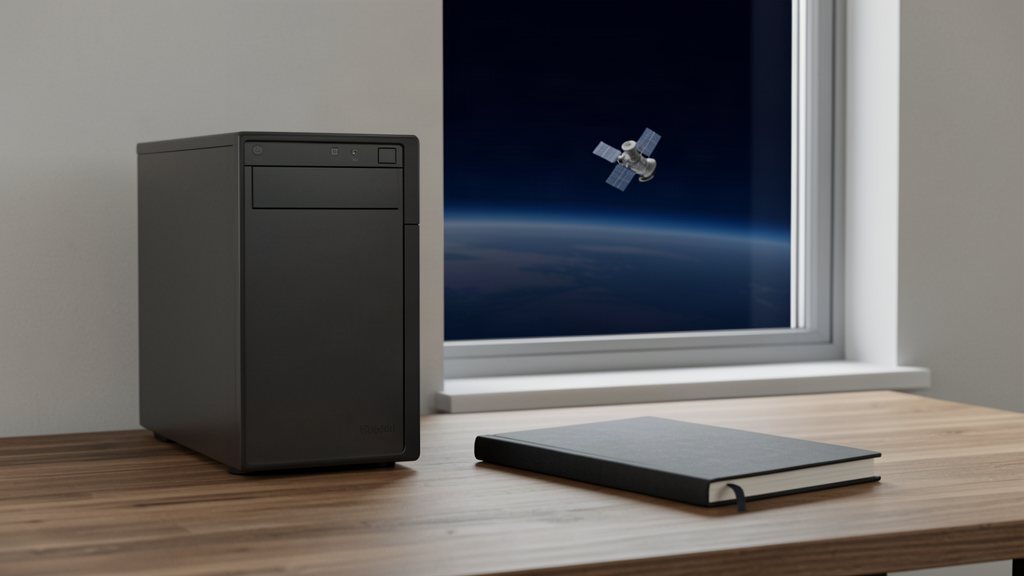
Editorial image: generated conceptual illustration of a desktop computer and satellite, not a photograph or depiction of Google’s Project Suncatcher.